
Your Clients Feel Gaslit. Be the Firm That Doesn’t.
Serving software buyers in an era of inflated pitches, AI, and eroding trust
Your next client walks into the first meeting already tired. They have been oversold before. They have lived through a deployment that underperformed and then been told it was their fault — their data, their team, their change management. They have sat in a demo that ran flawlessly on clean data and a perfect happy path, signed, and watched the magic evaporate the moment the product met their actual workflows. They arrive at your door carrying that history, and increasingly they arrive wondering whether you are just another extension of the vendor’s sales motion.
If you run a professional services firm that helps clients select and implement software, that wariness is the single most important thing to understand about your market right now. It is also your biggest opportunity. The firms that will win the next decade are not the ones with the most certifications or the deepest vendor relationships. They are the ones clients trust to tell them the truth — including the truths that cost the firm short-term revenue.
This is a piece about how to be that firm. It starts with empathy for what your clients are actually going through, because that empathy is not a soft skill here. It is the foundation of the only durable competitive position left.
What it feels like from your client’s chair
Start by naming the thing your client rarely says out loud: a good deal of what they experience as dishonesty is, legally, nothing of the kind. The vague superlatives in the deck — “seamless,” “enterprise-grade,” “AI-driven” — are puffery that no one is supposed to rely on. The specific promises made in the room get erased by a merger clause that says the contract supersedes whatever the salesperson said. Your client half-knows this, which is part of what makes the experience so disorienting. They cannot point to a lie. They just know the thing they bought is not the thing they were sold, and they cannot prove where the gap came from.
Then comes the part that genuinely deserves the word your clients reach for. When the software underperforms, the cause is honestly ambiguous — is it the product, the configuration, the integration, the data, the team? In that fog, the explanation that tends to win is the one that points back at the client: more training is needed, best practices weren’t followed, another phase of services will fix it. Often there’s real truth in that — data quality and change management genuinely do sink projects. But because the diagnosis defaults to the buyer, your client can end up doubting their own perception of whether the product works at all. No one has to be acting in bad faith for that to feel like gaslighting from the inside, and that feeling is what your client carries into the room with you.
Sit with the personal stakes, too, because your client is carrying a risk that never appears on any invoice. Whoever championed the purchase spent political capital to win the budget and beat the skeptics. If it fails publicly, that is their name on a visible misjudgment — sometimes a career-defining one. So when a deployment struggles, your client is not a neutral evaluator. They are a person with a powerful incentive to keep believing it will come good, to defend the choice, to accept the “we just need to use it better” story and repeat it internally, because the alternative is admitting they were wrong in front of their leadership. Understanding that pressure is the difference between an advisor who adds to it and one who relieves it.
Here is the uncomfortable truth for our profession: that dynamic is one a services firm can drift into without ever deciding to — keeping a struggling implementation on time-and-materials, leaning on the same “it’s fixable in phase two” story, letting a client’s fear of being wrong keep the engagement funded. Your clients have felt the cost of that drift. Some of them walk in assuming you will repeat it. Earning their trust starts with understanding why that assumption is reasonable, and being built to prove it wrong.
Why this is your opportunity, not your threat
Three forces are converging, and each one rewards the client-aligned firm and punishes the vendor-aligned one.
The first is collapsing trust in captured advice. Buyers have wised up to the fact that analyst rankings are influenced by relationship spend, that review sites are gamed, that the “independent” implementation partner was often introduced by the vendor during the sales cycle. The reflex now is suspicion. A firm that visibly separates its advice from its delivery incentives stands out precisely because so few do.
The second is AI, and it is reshaping what clients will pay for. A great deal of traditional services value was really information-asymmetry arbitrage — you knew the landscape, the failure modes, the realistic timelines, and clients paid for access to that knowledge. AI is rapidly commoditizing the shallow end of that. A client with a good prompt can now generate a category overview, a comparison matrix, and a list of sharp diligence questions in an afternoon. If your value proposition is “we know things you don’t,” it is eroding under you. If your value proposition is “we help you act wisely on what is now easy to know,” it is appreciating.
The third is the buyer’s lived exhaustion, the thing we opened with. A market full of burned, skeptical buyers is a market hungry for an advisor who is unmistakably on their side. That hunger is your demand signal.
What the data says your clients are doing
The behavior shift is not subtle, and it has direct implications for how you position your firm.
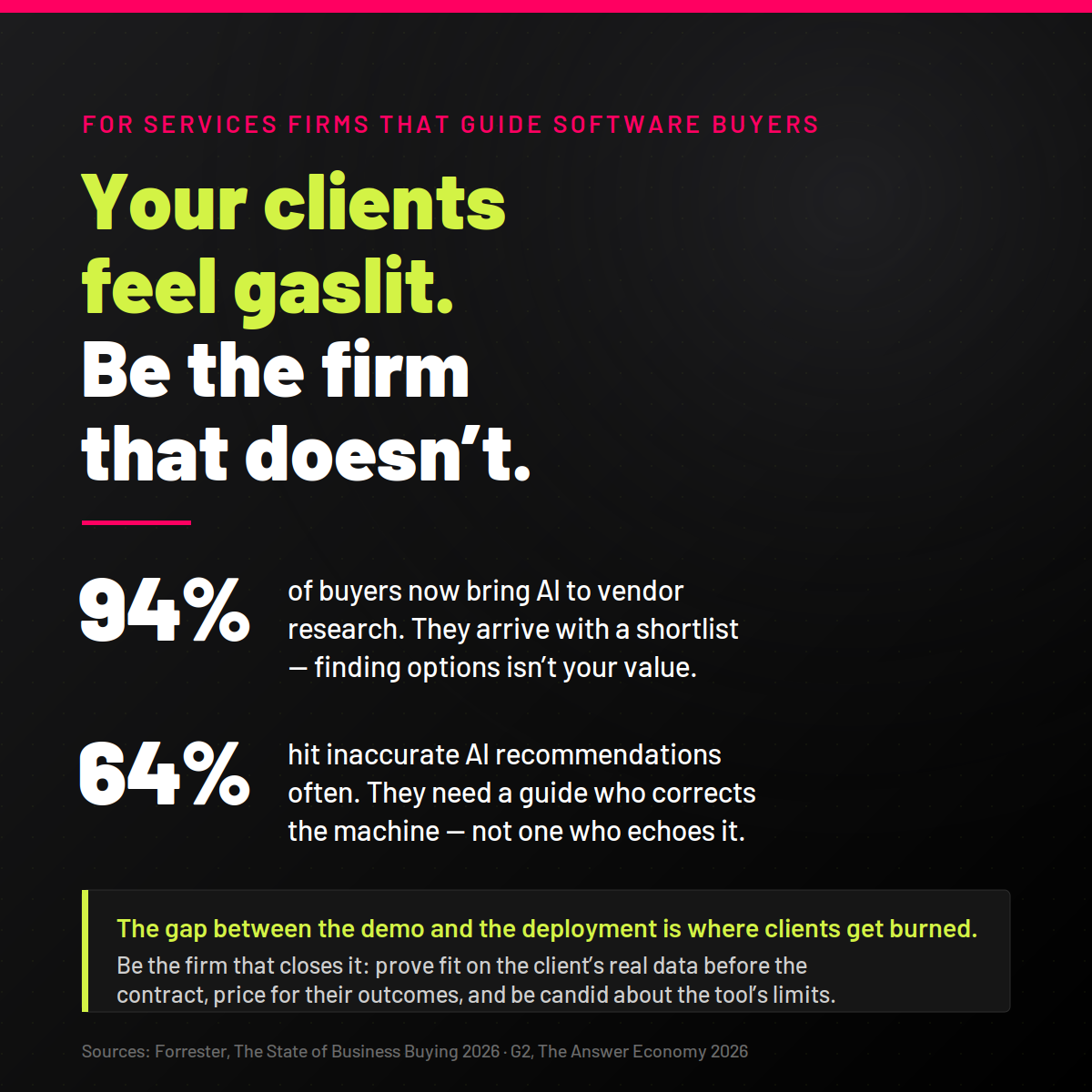
Buyers now bring AI to the table before they bring you. Forrester’s most recent Buyers’ Journey Survey found AI use in the purchase process rising from 89% to 94% across its two latest annual waves, and — more strikingly — twice as many buyers named generative AI or conversational search as a more meaningful information source than any other, outranking vendor websites, product experts, and sales reps. G2’s March 2026 survey of 1,076 B2B software buyers found 71% now rely on AI chatbots for software research and 51% start there more often than with Google, up from 29% a year earlier. Your client has very likely already formed a point of view and a shortlist before your first call.
But that research is shallow and often wrong. The same G2 study found 64% of buyers encounter inaccurate AI recommendations often or very often. And buyers feel the unreliability: in Forrester’s data, while many felt more confident using genAI, roughly one in five felt less confident after hitting inaccurate or unreliable information. Buyers are using AI to shop faster, not to buy more wisely — and they can sense the difference but not close it on their own.
That gap is the precise shape of your new value. Your client no longer needs you to find the options. They need you to do the thing AI cannot: correct the machine’s confident errors, pressure-test fit against their actual environment, and turn a fast shortlist into a sound decision. The firm that positions itself as the discovery engine is competing with a free tool. The firm that positions itself as the diligence partner is selling something AI just made more valuable.
How to use AI to serve clients better — not to bill them less honestly
The temptation, when a tool commoditizes part of your work, is to hide it and keep billing the old way. Resist it. Clients increasingly know what AI can do, and a firm caught charging consulting rates for what a chatbot produces in minutes will lose the trust that is your whole franchise. Use AI openly, on the client’s behalf, to deliver more value than they could get alone:
Synthesize the critical reviews, not the glossy ones. Pull the recurring complaints and real failure modes out of hundreds of reviews and forums — the two- and three-star signal the vendor never surfaces — and bring your clients the picture they would never assemble themselves.
Turn the deck’s vagueness into your client’s leverage. Convert “seamless” and “AI-driven” into specific, falsifiable questions and into warranted representations your client can put in the contract. This is advocacy work AI accelerates and clients deeply value.
Correct the hallucinations. When your client arrives with an AI-generated shortlist built partly on wrong information — wrong integrations, imagined certifications, outdated capabilities — being the expert who catches it is a trust-building moment you now get handed regularly.
Help clients use AI well themselves. Teaching a client how to run their own deep research, then validating and extending it, positions you as a partner rather than a gatekeeper. Counterintuitively, making your client more capable makes them more loyal.
What AI still cannot do is the part you should anchor your firm to: it cannot run the proof-of-concept on the client’s real data and workflows, and it cannot have the candid conversation with a reference customer your client sourced themselves. Those remain the highest-value diligence there is. A firm that owns those two activities owns the part of the process that actually de-risks the decision.
Building a practice clients trust by design
Empathy and good intentions are not a moat. Trust has to be built into how the firm is structured, because clients have learned to read structure, not promises.
Separate advice from delivery — and say so. The most conflicted question in our business is “should you buy this at all,” because the honest answer is sometimes no, and no means no revenue. The firms that win long-term make that separation explicit: a paid advisory engagement, with no stake in the implementation, that is genuinely willing to recommend against a purchase or in favor of a competitor you don’t implement. It feels like leaving money on the table. It is actually buying the credibility that wins the next three engagements.
Price for outcomes, not for difficulty.Time-and-materials billing quietly rewards you when an implementation drags — the exact incentive your clients fear. Fixed-fee and milestone- or outcome-based structures align you toward finishing, and tying payment to working acceptance criteria (defined on the client’s data, not a demo environment) tells your client that “done” means their outcome, not your hours.
Be honest about fit, especially when it costs you.The single most powerful trust signal you can send is telling a client the platform you implement genuinely cannot do the thing they need. The firms clients come back to are the ones that point at the product’s real limitations instead of only ever pointing at the client’s data and change management. That candor is the antidote to the gaslighting your clients have come to expect.
Make leaving easy. Insist that documentation and knowledge transfer are deliverables, that the client’s own team understands the configuration, that they are never trapped with you. Partner lock-in is its own version of the problem clients resent in vendors. A firm confident enough to make itself replaceable is a firm clients never want to replace.
Navigate your own vendor alignment in the open. Most services firms have real vendor relationships — certifications, referrals, margin. Pretending otherwise is the fastest way to get caught. Disclose it. Then show the client the guardrails: the independent fit assessment, the willingness to walk away, the references you didn’t hand-pick. Acknowledged conflict, well-managed, builds more trust than denied conflict ever could.
The flywheel
Put it together and the logic is almost embarrassingly simple. Your clients are exhausted by a market that oversells and then blames them. Be the firm that takes their side — that does the diligence AI can’t, tells them the truth about fit, prices toward their outcomes, and makes itself replaceable. That earns trust. Trust earns the referrals and the renewals and the right to be in the room for the next decision, which is where the real economics of a services firm live.
The vendors will keep running the demo. The AI tools will keep producing fast, confident, half-right shortlists. Your clients will keep walking in tired and wary. None of that is changing. What you can change is whether, in a market full of people angling to sell them something, you are the one they finally trust to help them buy well.
Sources and notes
Figures verified against primary sources as of June 2026. A caution in the spirit of this piece: each survey comes from an organization with a stake in the “AI is reshaping buying” story — Forrester sells research, G2 is a review site that benefits from being the trusted layer in AI search. Anchor on the direction, which independent surveys agree on, more than on any single percentage.
Forrester — The State of Business Buying, 2026 (drawing on Forrester’s Buyers’ Journey Survey, 2025). Source of the 89%→94% rise in AI use across Forrester’s two most recent annual waves, the finding that twice as many buyers named generative AI or conversational search as a more meaningful information source than any other, and the split sentiment on confidence (many more confident using genAI, roughly one in five less confident after encountering inaccurate information). https://www.forrester.com/blogs/b2b_buyers_make_zero_click_buying_number_one/ and https://www.forrester.com/press-newsroom/forrester-2026-the-state-of-business-buying/
G2 — The Answer Economy: How AI Search Is Rewiring B2B Software Buying (March 2026 survey of 1,076 B2B software buyers across North America, EMEA, and APAC). Source of: 51% now start research with an AI chatbot more often than Google, up from 29% in April 2025; 71% rely on AI chatbots for software research; 69% chose a different vendor than initially planned based on AI guidance; one-third bought from a vendor they’d never heard of; 64% encounter inaccurate AI recommendations often or very often; 45% cite review-site citations as the most confidence-inspiring signal in an AI answer. https://www.prnewswire.com/news-releases/new-g2-research-half-of-b2b-software-buyers-now-start-their-research-with-ai-chatbots-302742807.html
TrustRadius — Bridging the Trust Gap: B2B Tech Buying in the Age of AI (2025 report; survey of 2,058 technology buyers and 490 vendors, fielded January 2025). A more conservative trend line: occasional AI use rose from 17% in 2024 to 30% in 2025. https://solutions.trustradius.com/vendor-blog/bridging-the-trust-gap-b2b-tech-buying-in-the-age-of-ai/
Want more from The Wolf Tank? Click here to be notified when new posts are published.