
Your Deal Didn't Die. It Starved.
In the AI era, enterprise technology deals starve in the middle of the funnel — the exact stretch where buyers now research without you.
Every enterprise technology seller knows the deal that goes quiet.
Not the one you lose to a competitor — that one at least has the decency to end. This is the other one. Discovery went well. The demo landed. Champions were nodding. And then, somewhere between “this looks promising” and “let’s get the requirements down,” the thread goes cold. Nobody says no. The calendar invites just stop.
We tell ourselves a story about these deals. Budget froze. Priorities shifted. Wrong time.
Sometimes that’s true. More often, something quieter happened: the buyer ran out of information before they ran out of interest — and went to find it somewhere you’re not. Increasingly, that somewhere is an AI assistant.
That single shift reframes an old problem. The information gap in enterprise buying is not new. What’s new is that buyers now close it themselves, silently, through tools you don’t control and can’t see — and the answer they walk away with is only as good as the content those tools can find.
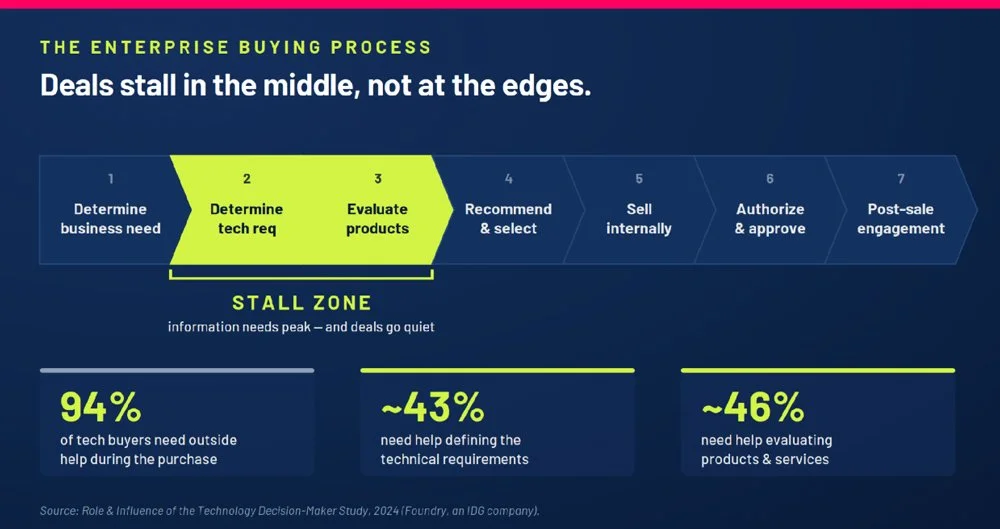
Buyers need the most help — and deals most often stall — while determining technical requirements and evaluating products and services.
That middle stretch is where deals go to starve.
And it is now also where they go to research — without you. This is precisely the zone buyers have pulled into self-service: Forrester finds 89% of B2B buyers now use generative AI for self-guided research, and Gartner reports two-thirds prefer to get through the purchase without a rep at all. The stall point and the point where the buyer disappears into a chatbot are no longer two problems. They are the same coordinate on the map.
Two questions nobody is answering
Strip the enterprise buying process down and the buyer is really trying to answer two questions.
IF we deploy this — is it worth it? The business case. The ROI model that survives contact with a CFO. The benefits justification. Evidence that somebody comparable to us did this and it worked.
HOW would we deploy this — and can we actually pull it off? The sequencing. The professional-services approach. The change management. Who staffs it internally, who we hire externally, what breaks in month four, and what it really takes to get from signed contract to working system.
Now ask yourself which of those two the ecosystem actually serves.
Vendor content answers a third question entirely: what does the product do? That’s not a criticism — product marketing exists to sell licenses, and it should. But feature content, however good, does not tell a VP of Marketing Ops how to sequence a phased rollout across three business units without torching her credibility internally.
Analysts operate on a different clock. Their horizon is two to five years, their frame is market position, and their metrics — breadth of functionality, completeness of vision — describe a market, not a deployment. “Comprehensive feature set” has never once helped anyone survive an implementation.
Partners and system integrators know the HOW better than anyone alive. It’s literally their job. But most of them don’t publish. They draft off the vendor’s marketing, wait for the RFP, and price the scope. The knowledge sits in delivery leads’ heads and dies there.
And peers — the buyers who did this exact thing eighteen months ago at a company just like yours — are almost entirely absent from the record. They get a stage at the vendor’s annual conference if they’re selected, which is to say if their story is flattering. The unflattering, useful version never gets told.
So the buyer, standing at the precise moment of maximum uncertainty, now types the IF and the HOW into a model — and the model answers with whatever it can find. If your ecosystem never published a credible answer to “how do you actually deploy this,” the machine does not return nothing. It returns someone else’s answer: an adjacent vendor, a competing ecosystem, a louder platform that did the work. The buyer gets an answer either way. The only question is whose.
When content is infinite, credibility is the only moat
The instinctive fix is more content. Publish harder. Fill the void. In the AI era, this is exactly the wrong reflex — and it’s worth being precise about why.
The marginal cost of producing plausible-sounding words has collapsed to roughly zero. Every competitor, every ecosystem, every content farm can now generate deployment guides and “thought leadership” by the thousand. The channel is not empty. It is flooding. Adding your own generated words to that flood does not fill the gap; it deepens it, and it makes you indistinguishable from the noise the buyer is already learning to ignore.
When decision-makers rank what they value in a technology content source, credibility comes out on top — ahead of depth, ahead of recency, ahead of format. Not “informative.” Not “comprehensive.” Believable. As synthetic content multiplies, that preference doesn’t soften. It hardens.
Which means the void is not a volume void. It’s a trust void. And in an age of infinite content, you cannot fill a trust void with more of the material that created it.
The machines doing the summarizing agree. When an AI assistant assembles an answer, it does not weight all sources equally — it leans on material it can treat as authoritative: earned, independently authored, third-party work, not vendor-owned pages. So the same content strategy fails twice over. Generic, self-interested material gets discounted by the human and skipped by the model that increasingly stands between you and that human. Credible, independent, human-authored content is not just more persuasive. It is the only kind that gets retrieved.
This is the uncomfortable part, and it’s where most attempts at fixing this collapse. Every player with the resources to produce great deployment content has an obvious reason to shade it. Vendors want the license. Partners want the statement of work. Analysts want the subscription and, sometimes, the vendor’s inquiry budget. Buyers know all of this. They apply a mental discount to everything they read, and the discount is roughly proportional to how badly the author wants something from them.
Here’s the trap: you cannot escape that discount by claiming neutrality. Nobody believes the claim, and asserting it loudly mostly signals that you know it’s a problem.
What actually works is narrower and more honest. Be transparent about who funds you. And then make the funding structurally irrelevant to the edit — a real firewall, a real editorial board, a real willingness to publish the case study where the deployment went sideways in month four.
Independence isn’t about who pays the bills. It’s about who controls the copy.
The tell is simple: can this publication print something its sponsor would rather it didn’t? If yes, the content is worth something. If no, buyers already knew, and priced it in.
The one thing the model can’t generate
There’s a second layer here that the industry systematically underserves, because it’s awkward to talk about — and it’s the layer AI makes more important, not less.
Every enterprise buying committee runs on two tracks at once. The rational track is the one everyone admits to: cost savings, revenue growth, operating efficiency, speed, quality, SLAs. Satisfying those is table stakes. Get them wrong and you’re not in the deal.
The emotional track is the one that actually decides. Will this make me look good? Will it make me look like an idiot? Will my peers respect this call? Does this advance my career or end it? Risk avoidance. Personal credibility. Standing inside and outside the organization.
Nobody puts “boost my self-confidence” in an RFP. But that is the operative question in the room, and the buyer resolves it the only way anyone resolves it — by finding someone like them who already made the call and lived to talk about it.
That’s not a content format. That’s a peer. And this is the hard limit of the machine: a model can summarize features, draft a comparison, even rough out an ROI case. What it cannot do is give a nervous VP the cover of knowing someone exactly like her already made this call and survived it. Peer validation is precisely what the ecosystem has almost no mechanism to provide. The staged conference case study doesn’t do it, because everyone knows it was staged. The reference call doesn’t do it, because everyone knows the reference was hand-picked. And AI can’t manufacture it, because it never happened. The more of the rational layer AI absorbs, the more the deal turns on the emotional layer it can’t touch.
Which is why anonymous experience is not a compromise — it’s often the only honest version. The deployment lead who’ll tell you candidly what she’d do differently will do it on the condition you don’t put her logo on it. Take that trade. The unattributed truth is worth more than the attributed press release, and buyers can tell the difference instantly.
The stall point is where AI-era buyers churn
Put the pieces together and the picture is stark. For years you could survive the content gap, because the seller was the buyer’s primary interface. If the content wasn’t there, the AE improvised. That safety net is gone.
The middle of the funnel — technical requirements, product evaluation, the stall zone — is now a self-service, AI-mediated space you are not standing in. The buyer enters it, asks the IF and the HOW, and the model answers from whatever credible material exists. If yours isn’t there, theirs is. No rejection email. No lost-to-competitor flag in the CRM. Just a shortlist that quietly formed without you, at the exact stage your pipeline is most exposed.
That is the churn nobody logs: not a deal lost in negotiation, but a buyer who resolved their uncertainty inside a chatbot before you knew the evaluation had started — and resolved it toward whoever fed the machine the credible answer.
Which is why “publish more” and “buy a platform” both miss. The two forces reshaping this stage pull in the same direction: buyers researching through AI reward the source the model trusts, and the flood of synthetic content makes that trust scarcer and more valuable by the day. The only durable response is to own the credible answer at the stall point — so you’re the source the machine surfaces and the buyer believes.
The work
None of this is a technology problem. There is no platform to buy.
It’s an editorial problem, and the fix looks like journalism more than it looks like marketing: go find the people who actually deployed the thing. Ask them the questions the vendor can’t ask and the analyst won’t. Publish what they say, including the parts that sting. Let them stay anonymous when candor requires it. Do it on a schedule, with real editorial standards, and be honest about who’s paying for the lights.
Do that, and something compounds. Better content attracts better sources. Better sources produce content nobody else can get — the kind the models cite and the buyers trust. And the buyer stuck at the requirements stage, one query away from disappearing, finds your answer instead of someone else’s.
The deal doesn’t churn. Not because anyone sold harder, but because when the buyer asked the question — of a rep, of a peer, or of a machine — you were the one who had already answered it.
Eric Rotkow spent twenty-five years in marketing operations and enterprise technology services, most recently founding and building Zee Jay Digital, a leading Adobe partner acquired in 2023.
Sources
[1] Foundry (an IDG company). Role & Influence of the Technology Decision-Maker Study, 2024. 94% of ITDMs need vendor assistance at some point in the purchase, peaking during technical-requirement determination (43%) and product/service evaluation (46%); credibility ranks as the top-valued attribute of a technology content source. foundryco.com/tools-for-marketers/research-role-and-influence
[2] Gartner. Sales Survey Finds 67% of B2B Buyers Prefer a Rep-Free Experience, March 2026. Survey of 646 B2B buyers (Aug–Sep 2025): 67% prefer a rep-free purchasing experience and 45% used AI tools during a recent purchase. gartner.com/en/newsroom/press-releases/2026-03-09-gartner-sales-survey-finds-67-percent-of-b2b-buyers-prefer-a-rep-free-experience
[3] Forrester, via Apollo. The State of the B2B Buyer Journey, 2026. 89% of B2B buyers now use generative AI for self-guided research; the majority of the buying journey occurs before vendor contact. apollo.io/insights/b2b-buyer-journey
[4] Muck Rack / industry analyses of AI answer engines, 2026. Independent analyses of generative-engine citations find AI answers draw overwhelmingly on earned, third-party editorial sources rather than vendor-owned pages — underscoring the premium on credible, independently authored content. Figures vary by study; confirm the specific source before citing a precise percentage.
Statistics reflect the most recent figures available at the time of writing and should be re-verified against the primary source before republication.
Want more from The Wolf Tank? Click here to be notified when new posts are published.