
The 18-Month Window: A Playbook for Owner-Operators of Adobe Services Firms
For founders and CEOs running Adobe-aligned services firms under $5M EBITDA who haven't taken outside investment
If you've built an Adobe services firm to somewhere between $10M and $15M in revenue, and you still own most or all of it, the next 18 to 24 months will probably matter more than the last five years combined. Not because of anything you've done wrong — your firm is likely solid, profitable, and growing. But the ground underneath you is shifting fast, and the choices you make in the next year will set your trajectory for the rest of the decade.
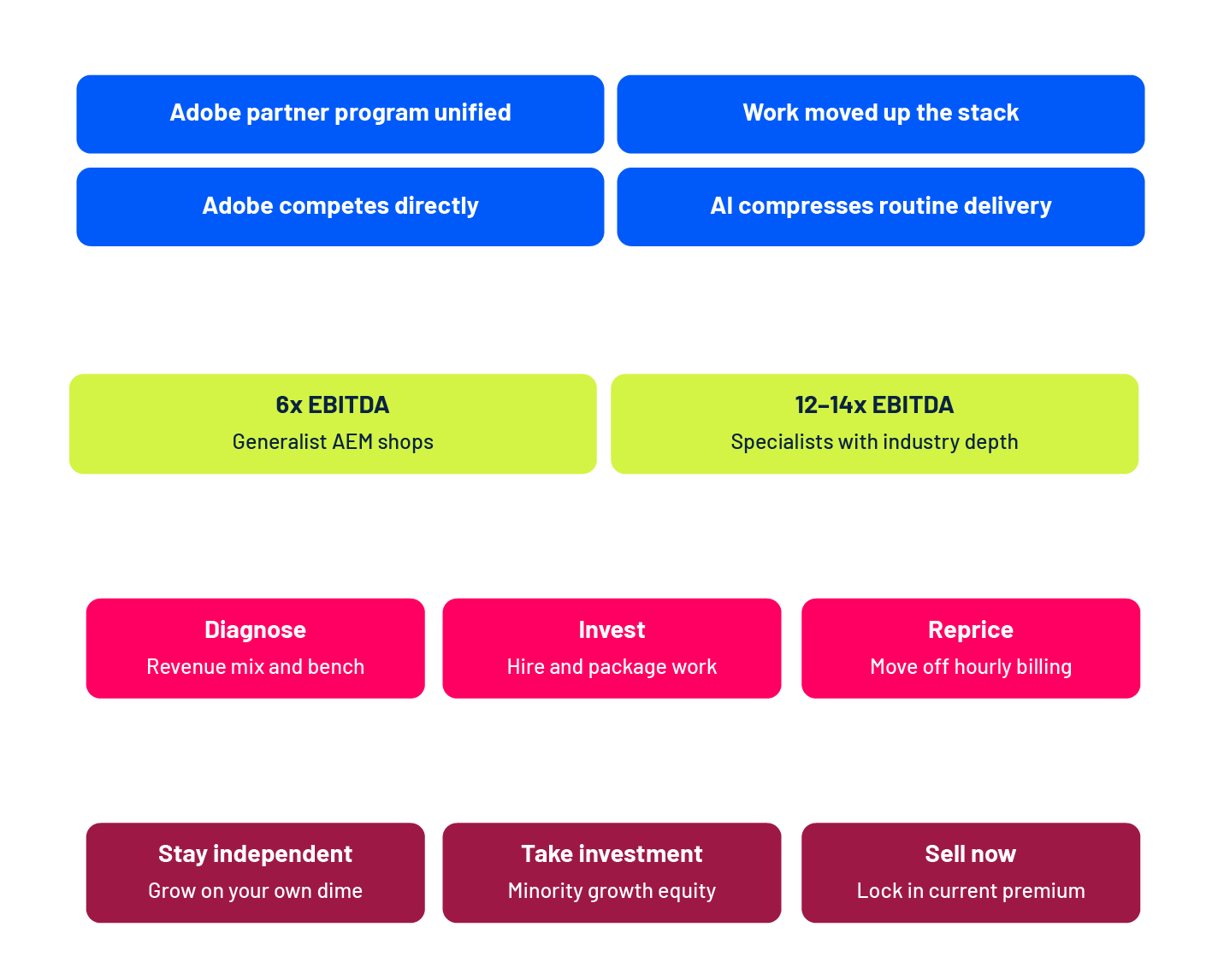
The market is already telling you the answer. Generalist Adobe shops — firms doing mostly AEM implementation work on hourly billing — are changing hands at around 6x EBITDA. Firms with deep expertise in Adobe Experience Platform, Real-Time CDP, Customer Journey Analytics, and Adobe Journey Optimizer, especially with focus on a specific industry, are selling at 12x to 14x. Same revenue, same profit, more than double the value to a buyer. That gap is going to widen, not close.
Whether or not you ever plan to sell, that valuation gap reflects something important: the kind of work that's defensible is changing. This is a guide to making the shift.
What's Actually Changing
You feel it already. Let me name the four things specifically.
Adobe collapsed the line between agencies and integrators.With the unified Digital Experience Partner Program that launched in March, Adobe stopped rewarding firms that do only creative or only technical work. The new program tiers — Community, Silver, Gold, Platinum — favor firms that can do both. If you're a half-stack firm, you're losing co-sell support and incentive dollars to firms that aren't.
The work itself moved. When a client buys Adobe in 2026, they're not really buying a content management system. They're buying an agentic system that connects Firefly, Workfront, AEP, AJO, and a growing catalog of AI agents. The work that pays well is no longer "stand up AEM." It's designing the content supply chain, governing the agents, and proving the outcomes. If your delivery team doesn't speak that language fluently within a year, you'll be quoting against firms that do — and losing. (For a deeper look at this shift, see From Implementation to Orchestration: The Future of Martech Services.)
Adobe is partly competing with you now. Adobe has been quietly expanding its own forward-deployed engineers — people inside Adobe doing the kind of strategic, high-value work that used to belong to partners. They're not trying to put you out of business, but they are taking the most interesting projects at flagship accounts. The territory you can defend is shrinking from above.
AI is making routine delivery work cheap. A senior developer with the right AI tools is shipping in two days what a three-person team used to ship in two weeks. That's good news if you bill by the project or by the outcome. It's bad news if most of your revenue still comes from billing hours.
An Honest Look at Where You Sit
Before you spend a dollar on any of this, be honest about your starting point. Most owner-operators I talk to are 18 to 24 months behind their own self-image. The exercise isn't complicated — it's just uncomfortable.
Pull last year's revenue and split it across five categories:
License resale and pass-through. Hurts your firm's value.
Standard AEM and AEP implementations on hourly billing. Commodity work. Worth roughly 6x.
Creative production retainers. High client churn, increasingly automated by AI.
Strategic advisory and architecture. Defensible if specialized.
AEP, RTCDP, AJO, and CJA practice work — especially with packaged offerings and industry depth. Premium work. Worth 12-14x.
If categories 4 and 5 together are less than 30% of your revenue, you're a generalist. Your firm is worth what generalists are worth, no matter how impressive the client logos look. Buyers see through case studies. They pay for the mix.
The second honest look is at your team. Count the people on your bench who have actually shipped production deployments of AJO, RTCDP, or CJA. Not the ones with certifications — the ones who've architected and delivered the real thing. For most firms in this segment, the answer is somewhere between 3 and 15. That number is your real position in the market. Almost everything else flows from it.
Where to Spend the Money You Have
You probably have $1M to $5M of money you could realistically invest each year — some mix of profit you could redirect, a line of credit, or savings. That's not a lot of room. Spending it well is what separates the firms that make this transition from the ones that don't.
Here's how I'd think about it.
Hiring senior people in the right specialties (40-50% of the budget)
Senior AEP, AJO, and CJA architects are the bottleneck for everything else you might want to do. They're scarce, they're expensive, and they're getting more expensive every quarter. Pay up.
The mistake most owners make is asking, "Can I afford to pay this person $300K?" The right question is: "Can I afford the cost of not having this practice when I'm bidding against firms that do, two years from now?" Three senior architects can let you compete for AEP-led work that would otherwise go straight to Accenture or Deloitte. The revenue from that is much bigger than the salary cost.
Equally important: keep the senior people you already have. The big firms are aggressively recruiting your best people right now, and it'll get worse. Equity, real career growth, and — this one is often overlooked — putting them on flagship work. Those things matter more than another raise.
Packaging your best work into repeatable offerings (20-30% of the budget)
This is the highest-return investment most firms underspend on. Take your three to five best types of engagement and turn them into packaged offerings — pre-built tools, agent skills you can publish on Adobe's catalog, industry-specific journey templates, audience taxonomies for specific verticals.
Two reasons this matters more for your size of firm:
First, packaged offerings let you compete on something other than price. A global firm will always undercut you on hourly rates. They can't easily copy a packaged "retail loyalty journey" that you can ship in 8 weeks instead of 26.
Second, packaged offerings make your firm worth more if you ever sell. Pure services revenue is valued like services. Services revenue with proprietary tools and recurring components is valued more like software. The difference at sale is enormous.
Plan realistically: a packaged offering takes 6 to 9 months and roughly $300K to $700K to build properly. Aim to ship 2 or 3 over the next two years.
Picking an industry and going deep (15-20% of the budget)
Pick one or two industries. Not five. Not "we serve enterprise broadly."
For firms your size, focusing on a specific industry is the single biggest lever for both growth and value. Financial services, healthcare and life sciences, retail and consumer goods, B2B technology, and media each have their own customer journey patterns, regulatory rules, and content needs. A firm with deep retail expertise on AEP wins against a generalist on every dimension that matters: more wins, better margins, more expansion work, higher value when sold. Our post Why Platform-Focused Agencies Should Go Vertical makes the case in detail and is worth reading before you decide which industry to pick.
Spending here looks like: industry-specific solution leads, advisors with real experience in the industry, showing up at industry conferences, building case studies tied to specific industry problems. Budget: $400K to $1M a year depending on how aggressive you want to be.
Building real agentic AI delivery muscle (10-15% of the budget)
You need an actual practice — not a Slack channel — that designs, governs, and operates AI agent workflows. That includes the tools to build agents on Adobe's Agent Orchestrator, the rules and guardrails clients are going to demand, and the way you'll bill for running agents in production.
The firms that figure out how to charge for outcomes ("we'll run your loyalty program at this performance level for $X per month") instead of hours will have a real advantage by 2027 and 2028. Start now. Internal capability building takes longer than you think.
A small hedge into adjacent platforms (5-10% of the budget)
Resist spending more here than this. The common mistake among Adobe-focused firms is to overcorrect into Salesforce or Microsoft to "diversify." That usually produces a firm that's mediocre at three things instead of great at one.
The smarter hedge is in nearby capabilities: data engineering on Snowflake or Databricks, identity resolution, the plumbing that connects MarTech tools together. These complement your Adobe core without diluting your story.
What to Stop Spending On
A few things I'd freeze or shut down:
Generic AEM bench expansion. If you're hiring junior and mid-level AEM developers in volume, you're scaling a commoditized practice. Stop.
License reselling. Low margin, no value to the firm, distracts from better work. Some firms do it for client relationship reasons; just be clear-eyed that it's a cost of relationship, not a profit center.
Pure creative production capacity. This is the most exposed segment to AI. If you have a big creative production team, the question isn't how to grow it. It's how to evolve those people into content supply chain operators.
Innovation labs without a deadline. Most firms your size can't afford real R&D. Anything that doesn't produce a packaged offering or a billable capability within 12 months is overhead.
The Three Paths in Front of You
Every founder in this segment is making a decision over the next 24 months, even if they haven't named it yet. Be honest about which path you're on.
Path 1: Stay independent and grow
This works if you're disciplined about specialization, comfortable with slower growth, and have the patience to compound for another 5 to 10 years. The risk: as larger firms consolidate the market, your access to flagship deals may shrink. The reward: you keep the company, the culture, and the upside.
If this is your path, the priority is making the strategic shift on your own dime. That probably means slower growth in the short term, redirecting profit into hiring and packaging, and accepting that some quarters will look worse before they look better.
Path 2: Take outside investment for the first time
This is the path most owner-operators eventually consider, and the next 18 months are an unusually good window to do it. Growth equity firms, family offices, and private equity buyers focused on the Adobe ecosystem are all active right now. A minority investment lets you keep control while bringing in money to make the moves above faster than your cash flow alone supports.
The honest tradeoff: you take on a partner with their own timeline, usually 3 to 5 years until they want a sale or another transaction. You'll have a board that meets quarterly. You'll have reporting requirements you don't have today. If you're not prepared for that, don't start the conversation.
If this is your path, the time to start positioning is now. Investors pay for the trajectory, not just the snapshot. Showing two quarters of momentum on the strategic shift before you go to market makes a significant difference in what you're offered.
A practical note: talk to multiple investors before you pick one. The good ones will be honest with you about whether they're the right fit. The bad ones will pressure you to move fast. Trust that signal.
Path 3: Sell now
This works if you've built genuine specialization, you're tired, and you'd rather lock in the value of what you've built than fight the next chapter. The premium being paid for specialized firms right now is real, and it won't last forever. As more firms make the transition, the supply of high-quality firms to buy increases, and prices come back down.
If this is your path, the practical timeline from "I'm ready" to closed deal is 9 to 14 months for most firms in this segment. Choosing the right banker matters more than people think. Pick someone who has actually closed deals in the Adobe ecosystem, not just generic services deals.
The worst position
If you're a generalist with $3M to $10M in EBITDA, no clear specialty, and no plan to develop one, you're in trouble. You're too small to be a buyer of other firms, not differentiated enough to be a premium target, and the market is moving away from your kind of work. The honest path: pick a specialty in the next 12 months, even if it means walking away from revenue, and rebuild toward a sale 24 to 36 months out.
A Note on How You Bill
This deserves its own conversation — our post The Death of Hourly Billing: Why Agency Pricing Is Changing Fast covers it well — but the short version: you have to start moving away from pure hourly billing now. Even if 80% of your revenue is hourly today, you need three things in motion within the next year:
Outcome-based pricing pilots — meaning you get paid based on what the work produces, not the hours spent — on at least two or three projects per year, with clients willing to try it
Subscription revenue layered on top of your packaged offerings — managed services for journeys, ongoing optimization, agent operations
Fixed-fee delivery for any type of project you've delivered more than three times
The clients who push you hardest on this are usually your best clients. They'll happily restructure their relationship with you to align on outcomes. Use those conversations to build the muscle, then expand it across the rest of your book.
What I'd Do in the Next 90 Days
If I were running a $1M to $5M EBITDA Adobe services firm right now, here's what I'd do in the next quarter:
Run the revenue mix analysis and see honestly what percentage of revenue is in the premium categories.
Count the senior AEP, AJO, and CJA architects on the team — names, not certifications.
Pick the one industry where you'll go deep, and tell the leadership team out loud.
Identify two or three packaged offerings to build, with budgets and owners.
Have a real conversation with yourself about which of the three paths you're on. Write it down.
If outside investment is even possibly in your future, start having early conversations with bankers and investors now — not to transact, but to learn the market.
The firms that come out of this period strongest will be the ones that made these decisions in 2026, not 2028. The window isn't theoretical. It's already partly closed. Premium prices exist right now because there aren't enough good firms to buy. Once there are, the premium goes away.
The Adobe services market five years from now will have fewer firms, a bigger overall market, and be much more concentrated in the hands of firms that made the shift early. Your job over the next 18 months is to make sure your firm is one of them.
Want more from The Wolf Tank? Click here to be notified when new posts are published.