
The Death of Hourly Billing: Why Agency Pricing Is Being Rewritten in Real Time.
For decades, agencies sold time: Hours. Headcount. Deliverables. That model is now breaking—fast.
AI has compressed execution costs. Clients are demanding measurable ROI. And the gap between effort and value has never been more obvious. Charging for time in a world where output is increasingly automated doesn’t just feel outdated—it’s becoming indefensible.
We’re watching the agency compensation model get rewritten in real time.
The Old Model vs. The New Reality
The traditional structures still exist—but they’re no longer sufficient on their own:
Legacy Models
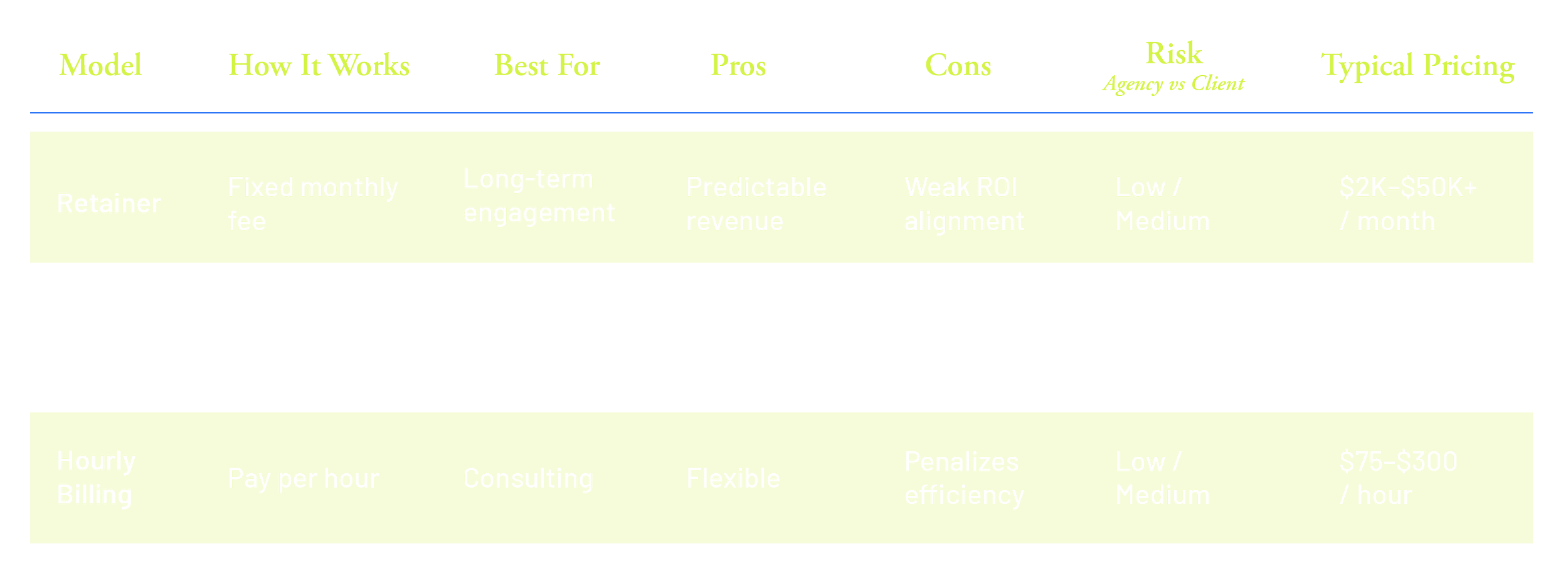
The problem? None of these models answer the only question clients care about: “What did this actually do for my business?”
The Rise of Outcome-Based Compensation
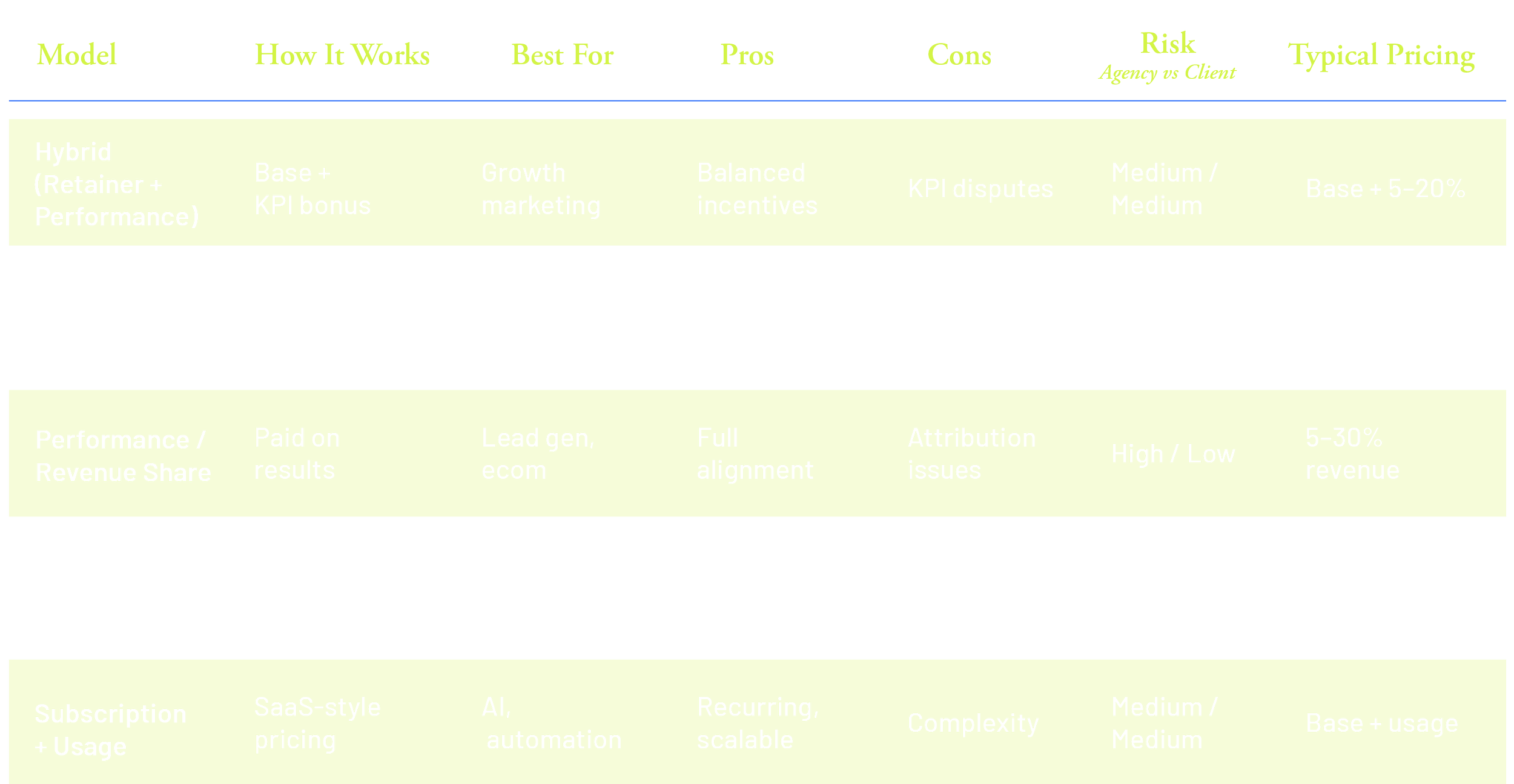
The new generation of agency models centers on one idea: Compensation should reflect impact—not effort.
Here’s what’s replacing the old guard:
Modern Models
Why This Shift Is Happening Now
Three forces are driving this change:
1. AI Is Destroying the Time-Based Model
When execution gets cheaper and faster, billing by the hour becomes disconnected from reality.
2. CFOs Are Getting Involved
Marketing budgets are under scrutiny. Vague deliverables don’t cut it anymore—ROI does.
3. Agencies Want Upside
Top agencies don’t want to be capped by hourly rates. They want to participate in the growth they create.
The New Agency Playbook
The smartest agencies aren’t choosing one model—they’re stacking them.
A typical modern structure looks like:
Base retainer → covers team + baseline delivery
Performance upside → aligns incentives
Productized layer → improves scalability
This hybrid approach balances:
Predictability
Profitability
Performance
The Hard Truth
Let’s be blunt: If your pricing is still based purely on time or deliverables, you’re competing in a race to the bottom. The agencies that win over the next decade will do one thing differently: They will price outcomes, not activity.
Final Thought
This isn’t just a pricing change. It’s a mindset shift.
From: “How much work did we do?” To: “How much value did we create?”
The agencies that embrace that shift won’t just survive—they’ll define the next era.
Want more from The Wolf Tank? Click here to be notified when new posts are published.