
When the Platform Buys the Challenger: What Salesforce–Braze Means for Your Services Firm
On October 20, Salesforce agreed to buy Braze for about $5.66 billion. The first wave of commentary covered the obvious questions: product overlap, Marketing Cloud’s future, and what Braze customers should do. For leaders of services firms, the more important question is different. When your clients’ platform choices consolidate, are you their advisor, or the platform’s delivery arm?
I spent years in the Adobe partner ecosystem, and I’ve watched this movie before. A platform buys the challenger, the partner landscape reshuffles, and firms that looked well positioned on announcement day end up on the wrong side of the change. The firms that came out ahead weren’t the ones with the most certifications in the acquired product. They were the ones their clients trusted to tell them what to do next.
This post looks at what history suggests, where Salesforce’s ecosystem differs from Adobe’s, and how delivery models, margins, and Agentforce change the calculation. It ends with a practical case for choosing the advisor role, what that means over the next 18 months, and a look at whether small Braze specialists should sell.
What history says happens to partners
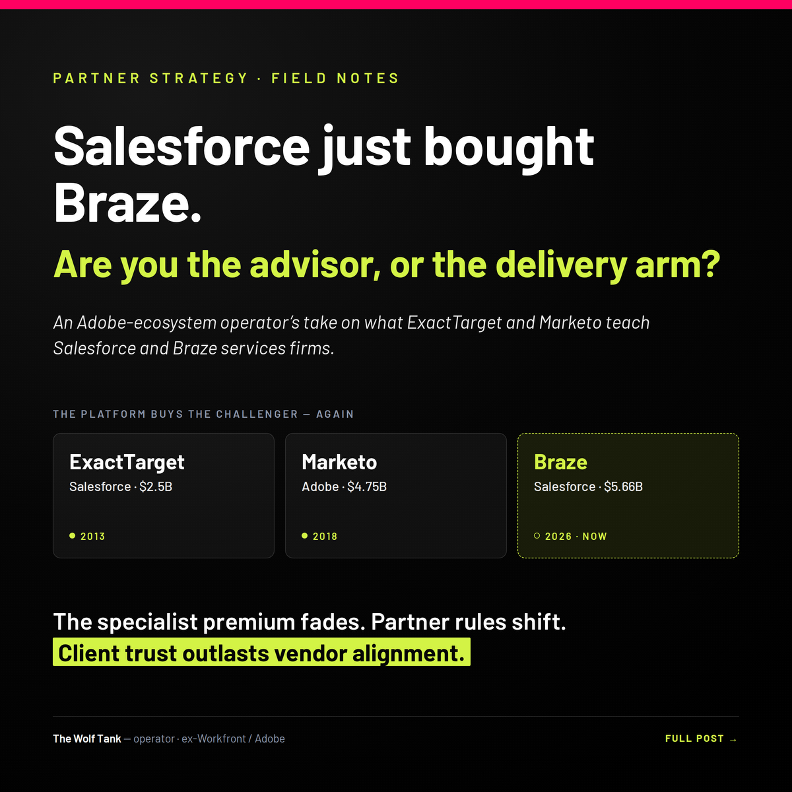
We have two close precedents. In 2013, Salesforce paid about $2.5 billion for ExactTarget, which became the foundation of Marketing Cloud. In 2018, Adobe paid $4.75 billion for Marketo. In both cases the acquired product survived and grew, but its partner ecosystem was transformed.
Three patterns repeated:
Specialist skills were scarce at first, then absorbed. For a period after each deal, specialists in the acquired product were in demand and expensive. Over time, larger partners hired or acquired that expertise, and the specialist premium shrank.
Rules about who got credit and access mattered more than the product. Once the acquired company’s partners were folded into the parent’s program, standing depended on the parent’s rules: tiers, co-sell access, how certifications counted. Firms that built relationships inside the parent early had a head start.
Client trust outlasted vendor alignment. Some clients had chosen the acquired product to avoid the parent. Firms seen as neutral advisors kept those clients, whether the clients stayed or moved. Firms seen as extensions of the new owner often lost them.
Braze adds a twist to the third pattern. As Scott Brinker noted this week, some Braze customers chose it specifically because it wasn’t Salesforce, and competitors are already pitching their independence. That makes the advisor question urgent now, not after the deal closes.
The Adobe lesson: selling to marketers is different
Adobe is very good at selling to marketing buyers. CMOs, creative leaders, and digital experience teams are its natural audience, and its partner ecosystem grew up around them. The leading Adobe partners blend agency and consultancy: they talk about brand, customer experience, and growth before platforms, and the platform work follows the strategy.
Salesforce’s center of gravity is different. Its strongest relationships are with sales, service, and IT leaders, and its partner ecosystem is built around implementation at scale. Marketing Cloud has been a weaker relationship with the CMO, and Salesforce’s marketing revenue has softened recently. Braze brings something Salesforce has struggled to build on its own: credibility with growth, lifecycle, and product marketing teams at mobile-first consumer brands.
For services firms, this is the key insight. The Braze buyer doesn’t buy like a Sales Cloud buyer. They expect a partner who understands engagement strategy, experimentation, and creative, not just configuration. Salesforce partners who learn to sell the way strong Adobe partners do (marketing outcomes first, platform second) will have an advantage. So will Braze specialists who can combine that marketing fluency with Salesforce’s data and engineering depth.
The delivery model is changing under your feet
The Braze deal lands in an ecosystem already under pressure. Salesforce says partners deliver about 70% of implementations, but the economics of that work are shifting in three ways.
Salesforce is moving closer to delivery. In April 2026, Salesforce launched its Forward Deployed Engineering (FDE) Partner Network. It extends Salesforce’s own engineering expertise and roadmap access to a select group of partners. The message is clear: Salesforce wants more control over whether Agentforce deployments succeed. Adobe partners will recognize the tension, since Adobe Consulting Services has long competed with partners on major AEM and AEP programs. The FDE network will likely create an inner circle with privileged access, and a wider ecosystem that has less.
AI is compressing implementation effort. Work that once filled large configuration teams is getting faster. Rate cards and utilization models built on hours are under strain, and Salesforce’s own professional services revenue has been flat to declining while subscriptions grow.
Pricing is shifting to consumption. Agentforce is moving toward consumption-based pricing (Flex Credits), and Salesforce is reworking partner incentives to match. Partners will increasingly be rewarded for driving usage and outcomes, not just for completing projects.
The implication: a Braze practice valued on billable hours is worth less than one valued on outcomes, reusable assets, and ongoing managed services. Firms should price and structure Braze-related offerings for the economics coming next, not the ones that are ending.
Agentforce makes this an engineering and data story
The deal’s most important rationale may be Agentforce, not Marketing Cloud. Braze responds to customer behavior in real time. That gives Salesforce’s agents a way to act on what a customer is doing right now, across apps, web, and messaging channels, not just on what’s stored in the CRM.
That changes what a marketing engagement looks like. Instead of building campaigns and journeys, firms will increasingly design marketing agents. These agents combine Salesforce’s customer data with Braze’s real-time signals, decide what to do, and act under guardrails the business sets. The firms that deliver the first convincing examples will help define the category, and will likely earn strong standing with Salesforce.
The skills this requires aren’t the ones most marketing practices are built on. Event streaming, data engineering, decisioning logic, and agent design matter more than campaign configuration. Brinker argues that martech is shifting from apps to infrastructure, with custom agents built on a few foundational systems. If he’s right, the lasting value is in building on those systems, not in operating any single vendor’s interface.
Choosing to be the advisor
Being the advisor doesn’t mean being anti-Salesforce. It means clients trust you to recommend what’s right for them, even when that’s not the newly combined platform. Over the next 18 months, that position is worth more than any single certification.
The deal isn’t expected to close until Salesforce’s fiscal 2028 (February 2027 to January 2028). Salesforce hasn’t said how Braze and Marketing Cloud Engagement will fit together. Clients will be making decisions before that answer arrives. Here’s what the advisor role looks like in practice:
Lead with stack assessments, not sales pitches. Every Braze customer and every high-volume B2C Marketing Cloud customer now has a reason to reassess. Offer an honest view of their options, including staying, consolidating, or moving to an independent platform.
Build migration skills that work in any direction. Marketing Cloud to Braze, Braze to an independent platform, or a later consolidation into one Salesforce stack all require the same core skill: mapping journeys, data models, and decisioning across platforms.
Invest in skills that hold their value under any scenario. Real-time data architecture, Data 360, and agent design pay off whatever Salesforce decides about the product roadmap.
Engage Salesforce early anyway. Being an advisor and being a strong Salesforce partner aren’t in conflict. Build relationships with Salesforce’s marketing and partner teams now, and document Braze and real-time results you can point to when the combined partner program is defined.
If you’re buying or selling a Braze practice, structure for retention. Some Braze clients may leave in the first year. Valuations should reflect that, and deals should keep key people engaged through the transition.
Should a small Braze shop sell?
For founders of small Braze specialists, the phone is already ringing. The honest answer is that it depends less on the deal headlines and more on four things: what your clients value you for, how portable your skills are, what buyers will actually pay for, and what you want next.
The case for selling now is real. History suggests the specialist premium peaks early and shrinks as larger partners hire or acquire the same skills. Today, Braze expertise is scarce and strategically visible, and buyers are competing for it. A year from now, that may no longer be true.
The case for waiting, or staying independent, is also real. The deal won’t close until Salesforce’s fiscal 2028, and nobody yet knows Braze’s place in the Salesforce product lineup or partner program. Buyers will price that uncertainty in, often through earn-outs that shift the risk onto you. And if your clients chose Braze to avoid Salesforce, an independent firm may be exactly what they want during the transition.
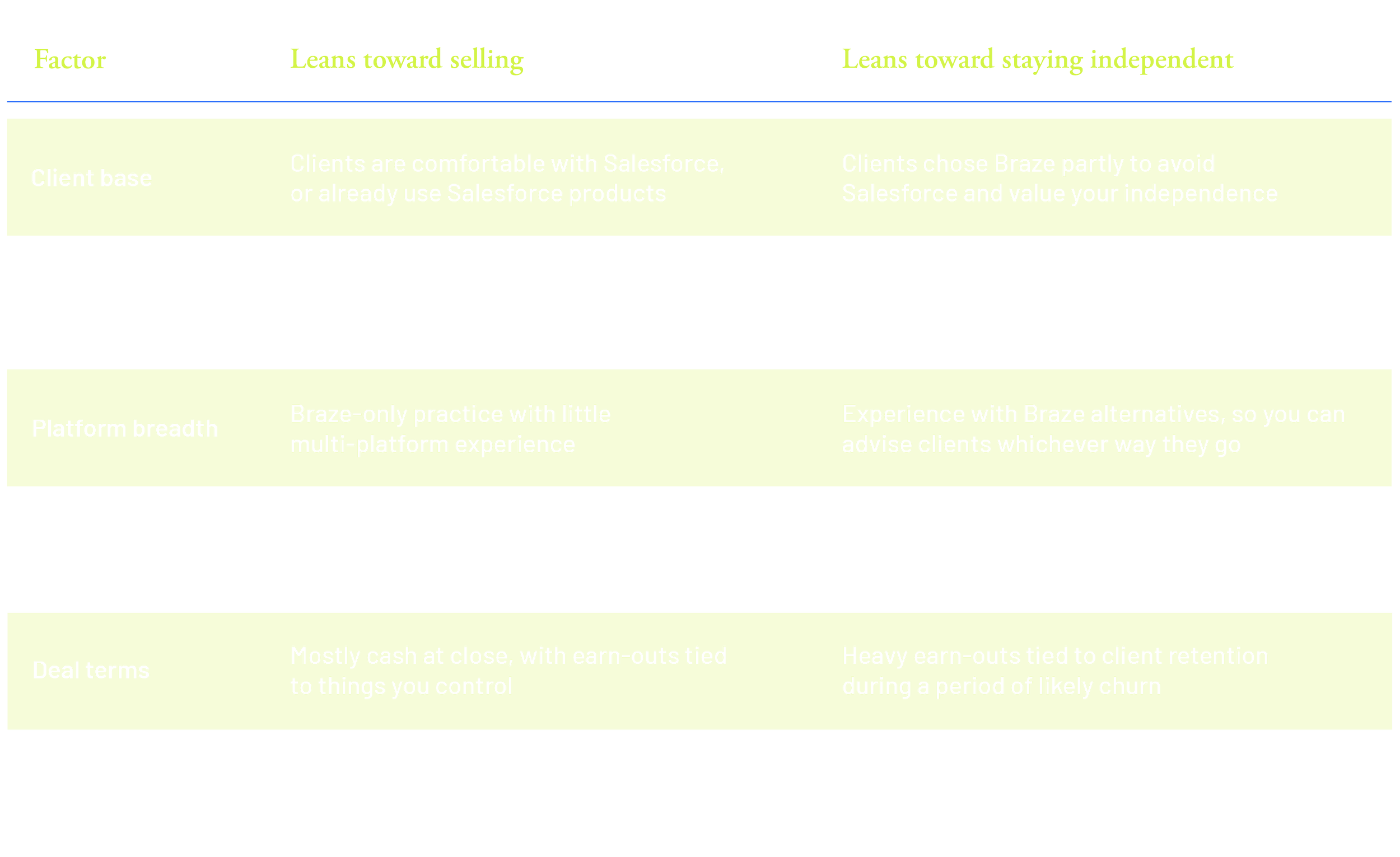
The table below summarizes the factors that tip the decision one way or the other.
A few questions to answer honestly before taking a meeting:
Which of my clients would stay if I joined a Salesforce-centric firm? Talk to your top clients before a buyer does. Retention risk is the single biggest driver of how a deal is valued and structured.
What is my firm really worth without the Braze label? If your value is in data and engineering skills, you have more options and more time. If it’s in Braze operations alone, the window is likely now.
Who is the right buyer? A global systems integrator, a Salesforce Summit partner, an agency holding company, and a private-equity roll-up will offer very different futures for your team and your brand.
Is there a middle path? Teaming agreements with a Salesforce partner, a minority investment, or a formal alliance can capture much of the upside while you wait for Salesforce’s roadmap to become clear.
The worst outcome is selling in a rush at a discount for uncertainty, then watching the clients that justified the price leave in the first year. The best outcome is a deliberate choice, made with a clear view of what your clients and your team actually value.
If you’re leaning toward selling, here are four steps to take now:
Partner with Salesforce firms to prove the synergies. Buyers pay for evidence, not potential. Work with one or two Salesforce partners on advanced use cases that combine Braze with Salesforce data, show the efficiencies a combined team creates for the buyer, and test a joint go-to-market approach. A track record of joint wins is worth more than any pitch deck.
Hire a Salesforce ringer. Don’t spend months trying to learn Salesforce from scratch while the opportunity slips through your fingers. One experienced Salesforce architect or practice lead gives you credibility with buyers and clients right away.
Start looking for a banker or advisor if you’re serious. A sale takes longer than most founders expect, between preparing the business, finding the right buyers, diligence, and negotiation. Starting the search now keeps you from running out of time while the window is open.
Differentiate with new delivery models. Buyers can find plenty of shops that know Braze. Outcome-based pricing, managed services, reusable assets, and agent-ready offerings set you apart from every other Braze shop and support a higher valuation.
Want to talk it through? If you’re weighing whether to sell, how to position your firm, or what buyers will look for, I’m happy to help, whether that’s an informal conversation or a formal advisory engagement. Reach out to me directly.
The firms that win the next chapter
Every platform acquisition creates a short window when clients are uncertain and looking for guidance. The ExactTarget and Marketo deals showed that the firms that won weren’t simply the most aligned with the acquirer. They understood the marketing buyer, built skills that outlasted any one product, and gave clients advice those clients trusted.
Salesforce–Braze is that window again, with higher stakes. Delivery models are shifting, margins are tightening, and Agentforce is changing what marketing work looks like. The firms that choose to be advisors now will be the ones both clients and Salesforce rely on when the combined platform takes shape.
Sources
• Salesforce signs definitive agreement to acquire Braze (Braze press release)
• CNBC: Salesforce to acquire Braze in $5.66 billion deal
• CMSWire: Why is Salesforce buying Braze, and what happens to Marketing Cloud?
• Scott Brinker: Martech consolidation, infrastructure, and the Braze-Salesforce deal
• chiefmartec: Adobe acquires Marketo
• Salesforce: Forward Deployed Engineering Partner Network
• CRN Asia: Salesforce partner ecosystem in 2026
• Solganick: Salesforce consulting partners M&A update, Q3 2025
Want more from The Wolf Tank? Click here to be notified when new posts are published.