
Where Adobe Partners Win in the Agentic Era
A look at how agencies, system integrators, and consulting firms are deploying AI today — and why the Adobe ecosystem is opening a different kind of opportunity.
The state of AI services across the broader market
Three years into the generative AI cycle, the services market has crystallized into a recognizable pattern. The era of pilots is over; the era of production is loud, expensive, and uneven.
The global systems integrators have industrialized agent delivery. Accenture launched AI Refinery for Industry with twelve pre-built industry agent solutions, building on more than 2,000 generative AI projects already delivered for clients. Its joint Forward Deployed Engineering program with ServiceNow, announced in May 2026, embeds combined teams inside customer environments to build agentic workflows directly on the ServiceNow AI Platform. The marquee public reference is the Best Buy deployment with Google Cloud — a generative AI virtual assistant across web, mobile, and contact center, paired with real-time agent copilots that analyze customer sentiment live.
Deloitte has emphasized regulated industries (financial services, life sciences, government), with its Quartz AI suite (Compass AI for logistics, Frontline AI for retail and QSR) on the NVIDIA stack, and an internal agentic AI deployment across its own global IT operations that it now sells as a service offering. IBM publishes figures from its Watson + Salesforce work including a 25-point NPS lift and roughly 45 minutes per day saved per agent. Capgemini partnered with Telenor to build an AI Factory; Wipro launched sovereign AI offerings for national governments; TCS signed Air New Zealand for AI plus large-scale workforce upskilling.
The marketing holding companies have become technology companies. Each is building its own agentic operating system. WPP launched Agent Hub on WPP Open in January 2026; its Choreograph platform uses multi-armed bandit algorithms to balance creative variant testing against budget exploitation. Omnicom rolled out an Acxiom-infused Omni platform at CES 2026 and introduced a Consumer Prompt Insights Agent with Google to decode search intent. Publicis acquired LiveRamp for $2.2 billion in early 2026 to anchor its CoreAI + Epsilon identity stack. Stagwell launched The Machine, built by Code and Theory and marketed by Stagwell as "marketing's first agentic operating system," in partnership with Palantir.
The boutique creative and digital shops are productizing too. Monks (S4 Capital) built Monks.Flow, a platform-agnostic AI suite, and was named runner-up for the Adobe Firefly Partner Award. Code and Theory's work for TIME, Qualcomm, Stanley Black & Decker, Henry Schein, and T. Rowe Price culminated in The Machine. VCCP's Faith division built Daisy, the scam-baiting virtual granny for O2. Bounteous productized its work into "Bounteous AI Experience Patterns" with Experience SLOs measuring time-to-value, adoption, and trust.
The named client wins are real and measurable. Coca-Cola's "Create Real Magic" platform drove thousands of creator submissions. Nutella generated 7 million unique label designs and sold the entire run. The British Council cut content production costs by 70% and accelerated campaign turnaround by 50% across seven languages. JPMorgan Chase saw click-through rates lift up to 450% on AI-generated ad copy variants. Harley-Davidson NYC used Albert.ai to dynamically adjust targeting, creative, and spend in real time.
The pattern is clear. Everyone is shipping. Everyone is winning some things. And almost everyone is building a proprietary orchestration layer they hope will become the next industry standard.
Where Adobe-aligned firms sit in this landscape
The Adobe partner ecosystem occupies an unusual position in this market. Adobe partners ship many of the same use cases as the broader agency and SI world — content production at scale, customer journey orchestration, agent-powered service, brand-trained generative models. But the architecture underneath looks different, and increasingly that's the point.
Consider the named work in the Adobe ecosystem. Adobe's published case study on Monks documents 96% faster banner versioning — 270 versions in a day — and 70% faster 3D asset creation, achieved by connecting Adobe APIs into Monks.Flow (numbers self-reported by Monks for the Adobe case study). Coca-Cola's collaboration with Adobe became the inspiration for Firefly Design Intelligence, which trains "StyleIDs" that codify a brand's visual identity rules and generate compliant layouts and copy across Creative Cloud apps.
Merkle (dentsu) has built one of the more visible Adobe-anchored AI practices in the market. Per Merkle's own announcement, it was the first agency partner to deploy Adobe Mix Modeler in a configuration that lets clients in-house integrated marketing mix models with real-time reporting — a claim originating from Merkle's press release, though other Adobe partners including Axamit and BlastX Consulting now also offer Mix Modeler implementation services. Adobe GenStudio dentsu+ combines Adobe's content supply chain with Merkury, dentsu's identity platform, giving marketers a single view across campaign management, content production, and identity mapping. Merkle and dentsu won the Adobe Summit 2025 Partner Innovation Award for GoToMarket for Experience Concierge — conversational AI agents built on Adobe's stack that guide retail shoppers from inspiration to purchase. Merkle reports lifts in conversion and AOV from the program, though specific figures haven't been independently published.
Adobe itself names the brands and agencies most active in its AI stack: The Coca-Cola Company, dentsu, The Estée Lauder Companies, Henkel, IBM, IPG Health, Lumen Technologies, Monks, The National Football League, Newell Brands, PepsiCo/Gatorade, Prudential Financial, Publicis Groupe, Qualcomm, Stagwell, and Tapestry.
Bounteous represents another shape — a full-stack experience consultancy doing AI inside Adobe stacks without being a marquee creative shop. Its QSR work consolidated siloed customer data and activated micro-segments through real-time personalization, producing an eight-figure annual incremental revenue increase and a 6% quarterly lift directly attributed to CRM activities. The pattern is more digital-transformation-with-AI than AI-led campaigns, and it's a pattern many mid-market customers actually want.
The honest comparison. Outside the Adobe ecosystem, the dominant play is "build our own orchestration OS." Stagwell's Machine sits on top of Figma, Slack, Teams, Adobe, and performance dashboards. WPP Open is a closed platform. Accenture's AI Refinery is proprietary. Inside the Adobe ecosystem, partners get to skip that fight — they package on top of Adobe's platform rather than competing with it. That sounds like a limitation. It's actually the opportunity.
A use-case-by-use-case scorecard
Here is the landscape mapped to the eighteen AI use cases agencies and SIs are actually shipping, with the broader market on one side and the Adobe partner ecosystem on the other
| Use case | Broader market | Adobe partner ecosystem | Position |
|---|---|---|---|
| Content production at scale | WPP Open Choreograph. Stagwell's Machine. Nutella 7M labels. JPMorgan +450% CTR. | Monks (Adobe case study): 270 banner versions/day, 96% faster. Coca-Cola StyleIDs. dentsu GenStudio+. | LEADS |
| Brand-trained generative models | Holdcos push “brands own models.” SIs offer fine-tuning on Azure, Bedrock, Vertex. | Firefly Foundry: private models across image, video, audio, vector, 3D. IP indemnified. | LEADS |
| Agentic CMS / autonomous content | Nascent. Sitecore, Contentful, Optimizely adding AI. Mostly template-driven still. | AEM officially Agentic CMS. Auto-generates regionalized landing pages from live signals. | LEADS |
| Personalization at scale | Salesforce Personalization, Dynamic Yield, Bloomreach. ZS Personalize.AI. | Target + RT-CDP + AJO is canonical. Coca-Cola, Estée Lauder, Tapestry references. | LEADS |
| Localization at scale | British Council 70% cost cut, 50% faster across 7 languages. Smartling, Lokalise. | Firefly Services APIs: video reframing, object compositing. dentsu translation built in. | LEADS |
| Brand visibility in the agentic web | Mostly experimental. Profound, Otterly. Omnicom + Google Prompt Insights at CES. | One of three CX Enterprise pillars. SEMrush acquisition adds SEO depth. Adobe defines it. | LEADS |
| Agentic operating systems | Accenture AI Refinery. Stagwell's Machine. Monks.Flow. WPP Open. All proprietary. | CX Enterprise Coworker on MCP + A2A. Open standards. Interoperates with every major LLM. | LEADS |
| Customer journey orchestration | Salesforce Agentforce. Braze, Bloomreach. ServiceNow + Accenture FDE. | CX Enterprise Coworker. RT-CDP + AJO substrate. Merkle Experience Concierge. | CONTESTED |
| Marketing mix modeling | Ekimetrics, Analytic Partners, Nielsen. Holdco proprietary: Annalect, Carat. | Per Merkle's announcement, first agency to deploy Adobe Mix Modeler with in-house client modeling. Axamit, BlastX also offer services. | CONTESTED |
| Identity resolution / first-party | Publicis Epsilon + LiveRamp $2.2B. Omnicom Acxiom. WPP InfoSum. Clean rooms. | Merkury, dentsu’s identity platform, is Adobe's identity partner, integrated with AEP. Real-Time CDP mature. | CONTESTED |
| Data foundation / readiness | SI bread and butter. 72% of orgs underestimate AI integration timelines, according to Databricks. | Adobe's own data: 75% cite integration as top challenge. AEP underutilized at most clients. | CONTESTED |
| Audience research / insight synth | Stagwell UNICEPTA +168% Q4. BERA +73%. Brandwatch, Sprinklr. VoC commoditizing. | CJA quantitative strong. Qualitative VoC typically requires third-party listening tools. | CONTESTED |
| Vertical agent libraries | Accenture: 12 industry agents. Deloitte Quartz AI. Wipro, TCS industry frameworks. | All 9 Big SIs packaging Adobe-anchored vertical agents per Summit. Mid-market open. | CONTESTED |
| Customer service / contact center | Best Buy + Accenture + Google. IBM/Watson +25 NPS, 45min/day saved. Cognigy at Bosch. | Possible via AJO + Coworker, but stack typically lives in Salesforce, ServiceNow, Genesys. | GAP |
| Programmatic media / ad activation | Holdco core. Choreograph, Omni + Acxiom, Epsilon + LiveRamp, Trade Desk, Albert.ai. | GenStudio integrates with Amazon Ads, GMP, LinkedIn, TikTok. Doesn't own DSP layer. | GAP |
| Enterprise IT / AIOps / internal | Deloitte agentic IT. Accenture + ServiceNow FDE. Capgemini + Telenor AI Factory. | Not Adobe's territory. Internal ops budget flows to SIs and ServiceNow/SAP/Workday. | GAP |
| Regulated industry copilots | Deloitte FS/life sci/gov. Accenture + OpenAI Enterprise. IBM watsonx. Wipro WeGA. | Present in CX use cases, including Prudential and IPG Health, but not core regulated workflows. | GAP |
| Enterprise Copilot rollouts | Publicis M365 Copilot for 114k. M&S 11k licenses. Accenture + ChatGPT Enterprise. | Adobe + M365 Copilot joint agents since Q2 2025. Not Adobe's primary territory. | GAP |
Reading the scorecard
Three patterns are worth pulling out.
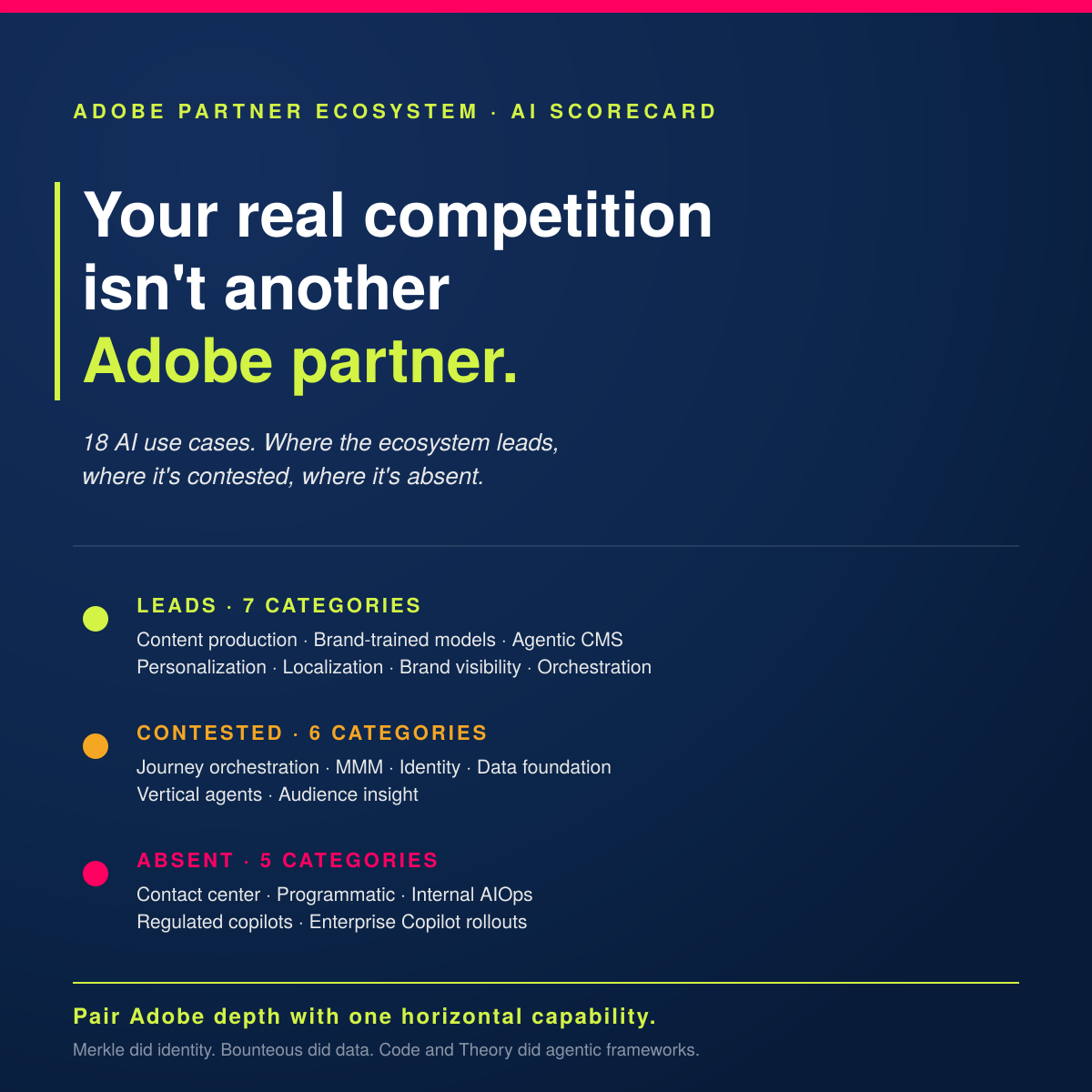
Where Adobe partners genuinely lead. Content production, brand-trained models, agentic CMS, brand visibility in the agentic web, localization, personalization, and agentic orchestration on open standards. Most of these are downstream of two structural advantages: Firefly Foundry for private models and CX Enterprise's open-standards architecture. They are difficult to copy from outside the Adobe stack.
Where the position is genuinely mixed. Journey orchestration, MMM, identity resolution, data foundation work, vertical agent libraries, and audience insight. These are categories where Adobe has good technology but customer outcomes depend on things adjacent to the platform — data maturity, third-party data assets like holdco ID graphs, or work that Adobe partners could sell but often deprioritize against more visible creative deliverables.
Where Adobe partners are honestly weak. Customer service and contact center, programmatic media buying, enterprise IT and AIOps, regulated industry copilots, and enterprise Copilot rollouts. These are not failures of execution. They are outside Adobe's scope by design. The risk is not losing them; it is letting them become the bigger budget line at the same client and watching another SI become the strategic partner.
The pattern worth naming: Adobe partners who pair their Adobe depth with one horizontal capability — data engineering (Bounteous), identity (Merkle/Merkury), agentic frameworks (Code and Theory) — are the ones turning amber rows green. Pure creative shops without that pairing risk getting boxed into the content-production lane while the rest of the AI budget consolidates elsewhere.
What Adobe is doing
At Adobe Summit 2026 in April, Adobe made the architectural bet explicit. The company unveiled Adobe CX Enterprise, replacing the Experience Cloud umbrella, organized around three pillars: Brand Visibility, Customer Engagement, and Content Supply Chain. The centerpiece is Adobe CX Enterprise Coworker, an agentic AI orchestration layer designed to span Adobe Experience Platform, Real-Time CDP, Customer Journey Analytics, and Journey Optimizer — and to reach across third-party systems.
The defining choice is openness. CX Enterprise Coworker is architected on Model Context Protocol (MCP) and Agent2Agent (A2A) — open standards rather than a proprietary integration layer. It interoperates with AI platforms from AWS, Anthropic, Google Cloud, IBM, Microsoft, NVIDIA, and OpenAI. That distinguishes Adobe from Salesforce and Microsoft, both of which orchestrate primarily within their own ecosystems.
Adobe Experience Manager has been repositioned as an "Agentic CMS," demonstrated at Summit autonomously generating regionalized landing pages with tailored imagery and tone in response to a traffic spike from a major golf tournament. Firefly Foundry lets enterprises train private models on their proprietary, branded content across image, video, audio, vector, and 3D. The GenStudio ecosystem now integrates with Amazon Ads, Google Marketing Platform, Innovid, LinkedIn, and TikTok for end-to-end activation.
The partner ecosystem moved in parallel. In March 2026, Adobe consolidated its Solution Partner Program and Technology Partner Program into the unified Digital Experience Partner Program, and launched PxHub — an AI-powered Partner Experience Hub. At Summit, Adobe formally named the agency partners (dentsu, Havas, Omnicom, Publicis, Stagwell, WPP) and SI partners (Accenture, Capgemini, Cognizant, Deloitte Digital, EY, IBM, Infosys, PwC, TCS) building agentic solutions on the Adobe stack for specific industry verticals.
The strategic signal: Adobe is not trying to win every layer. It is trying to own the orchestration spine and the content/data substrate, then let partners build the vertical depth and the implementation muscle.
Where Adobe partners have room to win
Five concrete opportunities stand out, given how the rest of the market is moving.
1. Vertical agent packaging at the mid-market. The Big SIs are claiming the Fortune 500 verticals. The gap is everything below — specialty retail, regional banking, mid-market QSR, life sciences sub-segments, education, tier-two public sector. These customers need pre-built agent libraries on CX Enterprise, not a fresh six-month strategy engagement. Boutique Adobe platinums and Adobe-native shops can own this layer if they move quickly.
2. The data foundation work nobody wants to sell but everyone needs. Adobe's own research found 75% of organizations cite data integration and quality as their top AI implementation challenge. Most Adobe customers have AEM, AEP, Real-Time CDP, and Journey Optimizer in fragmented states of implementation. The agentic layer cannot compensate for that. Partners who can do data unification + workflow redesign + change management — Bounteous and Merkle are already explicit about this — will see larger and stickier engagements than partners selling pure creative production.
3. Brand-trained Firefly models as a managed service. Coca-Cola's StyleIDs pattern generalizes to every brand that cares about visual consistency. The work is: train the model, build the asset pipeline, integrate with media activation, govern the output. Monks, Code and Theory, Merkle, and IPG Health are positioned to run this end-to-end inside the Adobe stack. Agencies operating outside the Adobe ecosystem can deliver similar outcomes using other foundation models — the Adobe-specific advantage is tighter integration into Creative Cloud workflows and Firefly's commercial IP indemnification.
4. Brand visibility in the agentic web. Adobe is building a category — measuring and influencing how brands surface in LLM-mediated discovery. It looks the way SEO did twenty years ago. There are no established players, no standard metrics, and no productized services. Early Adobe partners who claim the category can define it.
5. Agentic CMS re-architecture. AEM partners now have a fresh services line: re-architecting existing AEM implementations as Agentic CMS deployments. Competing headless CMS platforms are adding AI but haven't shipped equivalent agentic orchestration yet. The customers most likely to buy are those with heavy AEM investments and content velocity problems — exactly the customers most existing AEM partners already serve.
The risk worth naming: partners that stay only in CX delivery will get boxed out of the broader enterprise AI budget, which is consolidating toward horizontal SIs. The winning Adobe partners will pair Adobe depth with at least one horizontal capability — data engineering, MLOps, or operating model design.
What Adobe customers should expect
The next twelve to twenty-four months will be more disruptive for Adobe customers than the last three years combined. A few things to plan for.
Re-architecture, not upgrade. CX Enterprise is not a renamed Experience Cloud. It's an agent-based architecture with different mental models, different governance requirements, and different success metrics. Customers should expect a real re-architecture project, not a license swap. Tool-centric mental models — "we use AEM for content, AJO for journeys" — will give way to goal-oriented workflows where agents span the stack.
A data maturity reckoning. Customers who deferred CDP work or never finished AEP rollouts will hit a wall. Agentic orchestration cannot route around fragmented data; it amplifies its absence. Expect this to be the most expensive line item in CX Enterprise readiness.
Open standards as an evaluation criterion. MCP and A2A are no longer obscure protocols. Futurum's 1H 2026 survey of 830 organizations found 52% now cite agentic AI capabilities as an active criterion in enterprise software purchases. Customers should evaluate every vendor — including their existing agency's proprietary "operating system" — against open-standard interoperability. Closed orchestration layers will increasingly look like risk.
Human-in-the-loop as the design default. Adobe has been clear that design-time activities like campaign planning will use Human-in-the-Loop by default, with "LLM-as-a-judge" patterns for output validation. Customers should plan for governance design, escalation paths, and structured human review — not autonomous-everything.
Pricing model pressure. Adobe partners are already moving to outcome-based and volume-based pricing as AI compresses production hours. Customers should expect SOWs to shift away from FTE-hour accounting — and should push for it actively, rather than letting agencies sell the productivity gain back at the old rates.
Brand visibility becomes a managed discipline. Customers should start measuring how their brand appears in LLM-mediated discovery now, the way smart marketers started measuring SEO in the early 2000s. Adobe is building the category. Customers who treat it as a real practice — not an experiment — will be the first to see compounding returns.
Talent and AI literacy will bottleneck adoption. Adobe's research found 71% of organizations cite talent gaps and 68% cite unclear ROI. Customers should budget for enablement and change management at parity with technology spend. The line item most often cut first is the one most often responsible for failure post-deployment.
Agency roster consolidation. Customers running fragments of their Adobe stack across seven different agencies will face pressure — from procurement, from CX Enterprise's own orchestration logic, and from their own data teams — to consolidate. Expect "lead Adobe partner" RFPs to become common over the next year. Plan for them deliberately rather than reactively.
The bigger picture
The broader market is fragmenting. Holding companies are building proprietary OS layers. Big SIs are productizing agent libraries. Boutiques are racing to claim categories. Customers are stuck deciding which of seven competing agentic operating systems they want to bet on.
Adobe's bet is different: own the orchestration spine, anchor it on open standards, and let a deep partner ecosystem build vertical depth on top. If that bet plays out, Adobe partners get something the rest of the agency and SI market doesn't — a substrate that compounds rather than fragments. The opportunity is real. The window is narrower than it looks.
The smartest Adobe partners are already moving. The smartest Adobe customers should be too.
Sources
Adobe announcements and research
Adobe. "Adobe Redefines Customer Experience Orchestration Vision in the Agentic AI Era with Introduction of CX Enterprise." Adobe Summit, April 20, 2026. news.adobe.com/news/2026/04/adobe-redefines-custome-experience
Adobe. "Adobe Unveils CX Enterprise Coworker to Build Agentic-Enabled Workflows for Customer Experience Orchestration." April 20, 2026. news.adobe.com/news/2026/04/adobe-unveils-cx-enterprise-coworker
Adobe. "Adobe Expands Partner Ecosystem to Deliver Frictionless Workflows for Customer Experience Orchestration." April 20, 2026. news.adobe.com/news/2026/04/adobe-expands-partner-ecosystem
Adobe. "Adobe GenStudio Introduces New Scaled Content Production Capabilities, Enhanced Model Customization with Adobe Firefly Foundry and a Growing Ecosystem of Ad Delivery Partners." Adobe MAX, October 28, 2025. news.adobe.com/news/2025/10/adobe-max-2025-genstudio
Adobe / Oxford Economics. "Adobe 2026 AI and Digital Trends Report." February 2026. business.adobe.com/resources/digital-trends-report.html
Futurum Group. "Adobe's Ecosystem Evolution: Creating a Seamless Core for Partner Success." March 12, 2026.
Futurum Group. "Adobe CX Enterprise Coworker Aims to Disrupt Agentic AI in Customer Experience." April 21, 2026.
MarTech. "Adobe rebrands Experience Cloud as 'CX Enterprise,' goes all-in on AI agents." May 2026.
CMSWire. "Adobe Doubles Down on Agentic AI at Summit 2026." April 20, 2026.
CXToday. "Adobe CX Enterprise Coworker: Agentic AI Meets Enterprise CX." April 23, 2026.
Systems integrator and consulting firm work
Accenture. "ServiceNow and Accenture Launch Forward Deployed Engineering Program to Scale Agentic AI Across the Enterprise." May 6, 2026.
Accenture. "Accenture Launches AI Refinery for Industry to Reinvent Processes and Accelerate Agentic AI Journeys." January 6, 2025.
DigitalDefynd. "10 ways Accenture is using AI - Case Study [2026]" (Best Buy + Google Cloud reference).
DigitalDefynd. "Top 10 Copilot AI Business Case Studies [2026]" (Publicis, M&S, IBM/Watson references).
Addepto. "Top 10 AI Consulting Companies for Enterprise Transformation: A Practical Buying Guide (2026)."
TelecomTalk. "Wipro Sovereign AI, Capgemini Agentic AI, TCS Air New Zealand Partnership." NVIDIA GTC 2025.
Holding company and agency AI work
Stagwell. "Stagwell (STGW) Launches 'The Machine': Marketing's First Agentic Operating System." January 5, 2026.
Stagwell. "Stagwell Releases 2025 Annual Report: Positioning the Challenger Network as a Winner in the Age of AI." March 16, 2026.
Code and Theory. "Follow up from 2026 CES x Machine."
Adweek. "Inside the Agentic OS That Code and Theory is Teasing at CES." January 7, 2026.
Stagwell. "The First AI-Driven Anticipatory Design System for Publishers" (ContextLens + Real Clear Politics). November 8, 2024.
Campaign US. "Inside the C-suite at CES with Omnicom, Stagwell, Publicis and WPP." January 13, 2026.
Klover.ai. "WPP AI Strategy: Analysis of Dominance in Marketing, Communications AI" (Choreograph references).
AdExchanger. "Q4: Omnicom's IPG Merger Is An AI Test Case" (Publicis/LiveRamp acquisition). February 19, 2026.
Superside. "10 AI-Powered Agencies Blending Automation and Creativity in 2026" (Keenfolks, VCCP Faith references). April 2, 2026.
Pragmatic. "Best AI Advertising Campaigns 2026 | Case Studies" (Harley-Davidson + Albert.ai, Coca-Cola Create Real Magic).
Coupler.io. "AI Marketing Use Cases in 2026: Real Examples & Strategies" (Nutella, JPMorgan Chase references). February 18, 2026.
ALM Corp. "AI-Powered Marketing Automation in 2026" (British Council reference). March 16, 2026.
Adobe partner case studies
Adobe Business. "Monks case study" (96% faster versioning, 270 banner assets, Monks.Flow integration).
Monks. "Monks Is Awarded Two Artificial Intelligence Excellence Awards" (Adobe Firefly Partner Award runner-up).
Merkle. "Merkle Becomes First Agency Partner to Deploy Adobe Mix Modeler in Evolution of Deep Partnership Alliance." November 2024.
Merkle. "Merkle & Adobe Partnership — Customer Experience" (Experience Concierge, Summit 2025 Partner Innovation Award).
Merkle. "Dentsu Partners with Adobe to Introduce Adobe GenStudio dentsu+." 2025.
Bounteous. "QSR Customer Data Activation" (8-figure incremental revenue case).
Bounteous. "From AI Pilots to Proven Experiences" (Experience Patterns, Experience SLOs framework). October 7, 2025.
Bounteous. "Predictive AI is Creating Big Moves for QSRs." January 29, 2025.
Note: figures cited from third-party listicles (e.g., Coca-Cola creator submissions, JPMorgan CTR lift, Nutella label run) trace back to originating brand or vendor case studies; readers should verify the underlying source before quoting in their own work.
Want more from The Wolf Tank? Click here to be notified when new posts are published.